
3.1 Discover What Your Target Audience Is Searching For

Photo by Tiffany Davidson
Keyword research is crucial to good SEO & acts as the necessary foundation to all other SEO efforts.
What is keyword research?
Keyword research is the process of discovering what your target audience is searching for on search engines such as Google.
Once we hone in on these keywords, we can then develop strong pages to target these keywords so that we rank on Google, thus getting found by our ideal audience.
Keyword research informs all other SEO efforts such as on-page SEO and knowing what to blog about.
Traffic Sources
If I look at my recent traffic for this site, I can see that most (65%) of my traffic comes from Google.
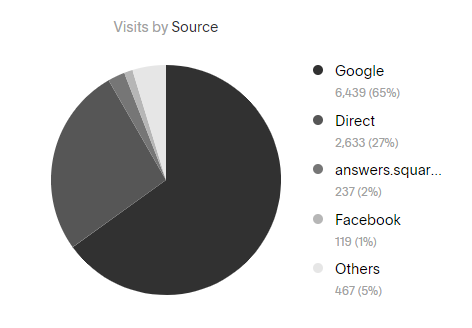
This was accomplished via keyword research, then creating content around those keywords, and injecting them into my sitemap.
How to find keywords for your site
This is the million dollar question, and certainly the one I get asked the most. But the answer isn’t simple. It’s a process, an investigation, a system that must be learned and understood. But this part is crucial because keyword research is THE most important part of SEO in my opinion.
So let’s jump in!
begin with the core description of your website
Before we start branching out into keyword research, our starting point needs to be our core offering, meaning- the primary services or products we provide, and to whom or where we specifically provide those (if applicable).
From this first general keyword, we’ll discover many more keyword ideas, but we need a primary keyword as a jumping off point to begin. And this keyword should be specific, not general.
For example:
if you photograph weddings in the Monterey, CA area, your starting point for keyword research will be: “wedding photographer monterey ca” (not merely “weddings” or “wedding photographers”)
if you create logos for real estate companies, your starting point for keyword research will be “logo designer real estate” (not merely “logos”)
if your website focuses on health and wellness articles, your starting point might be “health and wellness websites” (not merely “health”) — you might also gear your keyword research around specific modalities you work with such as “gaps coach near me” or “autoimmune paleo coach”
if, like me, you design websites using the Squarespace platform, your primary keyword will be “squarespace web designer” (not merely “squarespace” or “squarespace website” or “web designer”)
if you run a plant nursery in Port Townsend, WA your primary keyword will be “plant nursery port townsend wa” (not merely “plants” or “greenhouse”)
if you sell ebooks about how to train Corgi dogs, your primary keyword will be “training corgi dogs” or “corgi puppy training” (not “corgis”)
if you create ASMR cooking videos on YouTube and want to create your own site, your primary keyword could be “asmr cooking” (not merely “asmr”)
if you are a plastic surgeon in Beverly Hills, CA, your primary keyword will be “plastic surgery beverly hills” (not merely “plastic surgery”)
if you’re a stay-at-home mom and looking to start a lifestyle blog, your primary keyword will be “stay at home mom blogs” (not merely “mom blog” or “websites for moms”)
I can go on and on, but hopefully this list has helped you better understand how to locate target keywords (and avoid the overly general ones).
Depending on your website/business, you might have several primary topics (keywords), not just one.
For example, not only do I specialize in Squarespace web design, but also Squarespace SEO. So I would write down “squarespace web designer” and “squarespace seo” as two of my primary jumping off points for further research.
Let me provide more examples of what I mean, using the same list from above:
You photograph weddings in the Monterey CA area, but you might have a specific interest in capturing those who are looking to have a destination wedding in Big Sur. So you would also add the keyword “big sur destination wedding” to your list of primary keywords.
You create logos for real estate companies, and you specifically would like to work with local businesses in your city of, let’s say, San Francisco. So you would also add the keyword “real estate logo design san francisco” to your list of primary keywords for further research.
You write health and wellness articles, but one of your specific focuses is creating dessert recipes that are sugar-free. You would also want to add “sugar free dessert recipes” to your list of primary keywords.
You run a plant nursery in Port Townsend, WA that specializes in fruit tree grafting. Maybe one of your primary sources of income is from workshops teaching others how to graft their own fruit trees, so this is something you want to target on Google. You would want to add “fruit tree grafting port townsend” or “fruit tree grafting workshop washington” to your list of primary keywords.
You write ebooks about training Corgi dogs, but maybe a more specific topic you specialize in is training Corgis to swim. You would want to add “teach corgi to swim” to your list of primary keywords.
You create ASMR cooking videos, but a lot of your videos are also made outdoors. So you would want to add “asmr cooking outdoors” to your list of primary keywords.
You’re a plastic surgeon in Beverly Hills, but are most well-known for your breast augmentation procedure. You would want to add “breast augmentation beverly hills” to your list of primary keywords.
You’re a stay at home mom wanting to blog about the lifestyle, but you also want to teach other stay at home moms how they can earn money from home by creating their own blog. You would want to add “stay at home mom blog make money” or “stay at home mom income” to your list of primary keywords for further research.
Note: I’m not just making these keywords up or compiling them randomly, I’m testing them on Google and letting google show me what people are searching that relates to my website. this will become more clear in subsequent lessons and video demonstrations.
your assignment
Before moving to the next lesson, think about what your site is offering at its most fundamental level.
Write down at least three primary keywords your target audience(s) might be searching for. Does your website require location-specificity? If so, which specific areas will you target? (Maybe you live in Bowling Green, KY but would like to target Nashville, TN because it’s the closest densely populated area).
To help with this, try to imagine you are someone else out there who doesn’t know about your website or business. What would you potentially type into Google in order to discover your service(s) or product(s) or content?
Write down as many primary keywords come to mind. We’ll be using these in the next lesson to get more specific with our keyword research, and to start branching out into more and more ideas so that we capture all potential audiences who might benefit from finding our site.

Welcome to Squarespace SEO Expert! In this course I'm going to teach you the exact process I use to rank Squarespace websites on Google Page 1, using no paid advertising, only organic SEO techniques. If at any point you have questions, please use the comment feature at the bottom of the particular lesson you have a question about. I'm happy to help!

-
1. Introduction
- Mar 2, 2020 1.1 Welcome!
- Feb 3, 2020 1.2 What Is SEO? Why Is It Important?
-
2. Anwering Questions
- Jan 3, 2020 2.1 Necessary Initial Questions
-
3. Keyword Research
- Dec 3, 2019 3.1 Discover What Your Target Audience Is Searching For
- Nov 3, 2019 3.2 Using Suggested Keywords
- Oct 3, 2019 3.3 Keyword Planner Tool
- Sep 3, 2019 3.4 High-Intent Keywords
- Aug 3, 2019 3.5 Generating Blog Post Topics
- Jul 3, 2019 3.6 Site Meta Title & Description
-
4. Applying On-Site SEO
- Jun 3, 2019 4.1 SEO Title and Description Fields
- May 3, 2019 4.2 Optimizing Image Files Before & After Uploading
- Apr 3, 2019 4.3 On-Page SEO
- Mar 3, 2019 4.4 Understanding The Sitemap
- Feb 3, 2019 4.5 Blogging For SEO
-
5. Moving Forward
- Jan 3, 2019 5.1 Using Google Search Console
- Dec 3, 2018 5.2 Consistent SEO Blogging
- Nov 3, 2018 5.3 Adding New Content
- Oct 3, 2018 5.4 Epilogue
Copyright
© 2020-2024, All Rights Reserved
All content in this course is created and owned by me and cannot be used or sold elsewhere. Thank you for appreciating and valuing my work and experience.